

Industry Outlook
August 2025
Does Your Business Qualify as Mission Critical?

Mission critical businesses provide essential products or services that ensure the survival of organizations. Their predictable and stable revenue streams make them highly valuable to investors and acquirers, enhancing business valuations and attracting interest from potential buyers.

001
001
The Value of Mission Critical Businesses
Why Companies Are Considered to be More Valuable to Acquirers
Mission critical products or service providers can be found in many industries. Their non-discretionary nature typically makes their revenue streams predictable and stable – which are highly desired business characteristics for investors and acquirers.
Mission critical aspects of a business are those that are essential to the survival of an organization (commercial, government, community), and if the products, services or teams required to support these mission critical activities are not internal to the organization, the external organizations providing these products and services are mission critical companies.
Therefore, there could be layers of mission critical entities within the vertical integration of an overall industry. For example, a properly functioning hospital is mission critical for a community. A hospital that provides necessary in-patient, trauma and surgical care must have power at all times requiring a hospital to have 24/7 backup power availability in place. Therefore, backup power system providers, equipment service and repair firms, and parts manufacturers would all be part of a mission critical ecosystem, so each could rightfully claim they provide mission critical products or services.
Examples of Mission Critical Businesses
Below is a non-exhaustive list of business types frequently considered mission critical, illustrating the breadth and opportunity in this category:
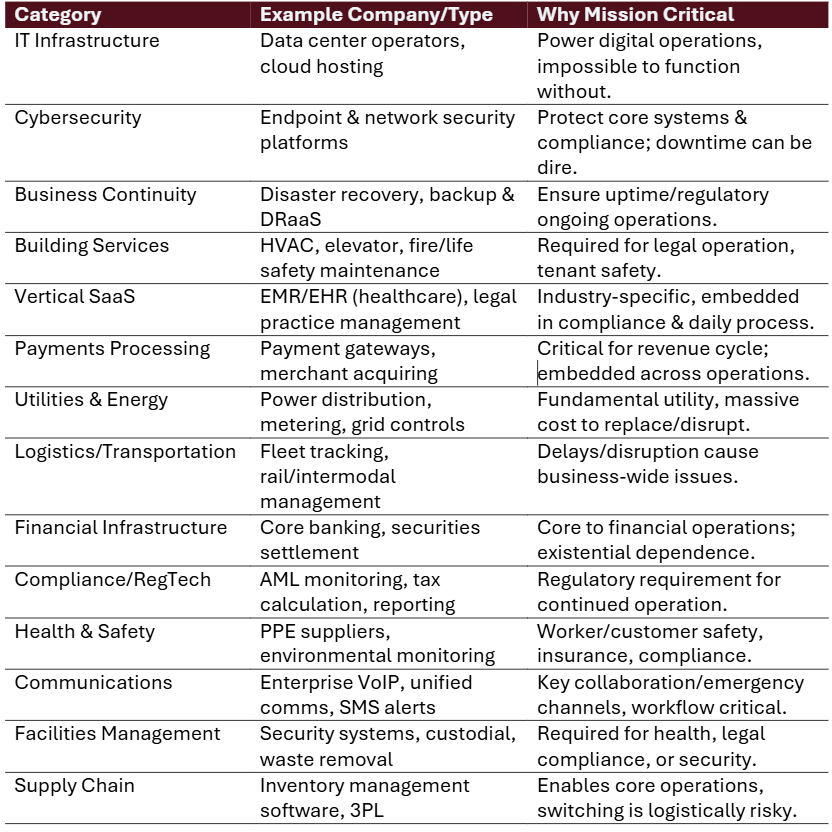
Characteristics of Mission Critical Businesses
- Have embedded and specialized technology in their products or services that generally cannot be developed, created and managed by their clients’ in-house teams.
- Have a workforce with specialized expertise that is not readily available and would not logically be employed directly by their clients.
- Provide products and services with stringent requirements related to accuracy and up-time, requiring monitoring or specialized (and costly) equipment that any one client would not possess.
- Provide products or services that are embedded in their clients’ contingency plans.
- Provide products or services that represent non-discretionary spending by their customers.
Often the term “mission critical” investment is interpreted as being related to aerospace, defense and other government spending, as well and spending on IT infrastructure and security. However, mission critical can be descriptive of many types of businesses, if the proper “lens” is applied and that lens is “would our clients’ businesses be inoperable for a period of time or would it be meaningfully damaging to them if a company like ours did not provide our products or services to them?”
The reason this is important for business owners to consider is that if a business is considered to provide mission critical products or services to any industry or even to individual consumers, it generally has higher business valuations.
The Strategic Magnetism of Mission Critical Businesses in M&A
In today's competitive and uncertain business climate, acquirers are placing a premium on companies that are “mission critical.” These are the businesses whose products and services are so integral to their customers’ operations that, if disrupted, the ripple effects would be immediate and potentially catastrophic. As M&A activity continues to rebound and private equity firms, strategic buyers, and even sovereign wealth funds sharpen their acquisition criteria, mission critical businesses consistently emerge as especially attractive targets.
Why Mission Critical Enterprises Command M&A Premiums
1. Revenue Resilience
The recurring and non-discretionary nature of mission critical products makes their revenue streams robust—even during downturns. Customers must continue using these services despite volatility, making forward earnings highly predictable.
2. Pricing Power
Because customers rely heavily on mission critical providers, these companies often enjoy strong pricing power. Even modest price increases are accepted, as the alternative—switching to a competitor or in-sourcing—is frequently impractical. This leads to impressive gross and EBITDA margins, which buyers greatly value.
3. Embeddedness and High Switching Costs
Mission critical solutions are often deeply woven into customer systems and processes, sometimes through custom integrations or compliance requirements. The perceived (and real) risk of switching providers makes churn rates exceptionally low.
4. Attractive Cash Flow Profiles
Stable, recurring revenues paired with low churn and strong pricing power generate stable and often growing free cash flow. Many buyers prioritize healthy, dependable cash flow as a key screening metric, and mission critical businesses frequently deliver above average results.
5. Defensibility Against Disruption
Mission critical companies tend to be better insulated from competitive disruption, technology shifts, and price wars. Their customers’ dependence acts as a natural moat, and their solution becomes “sticky” as processes, reporting, training, and even regulation are built around their offering.
6. Scalability and Platform Value
These businesses often provide an ideal foundation for creative buyer strategies, such as buy-and-build/consolidation plays, adjacent vertical expansion, and the addition of new revenue-generating modules. Their high customer retention, scalable platforms, and cross-sell potential make them appealing “platform” investments for private equity and strategics alike.
7. Higher Valuation Multiples
Empirical data show that mission critical businesses consistently trade at premium EBITDA multiples compared to non-critical peers. Strategic and financial buyers are willing to pay up for durability, margin profile, and growth prospects—especially in uncertain markets.
Market Outlook: The Future Is Bright for Mission Critical Companies
Despite cyclical headwinds, global M&A involving mission critical businesses remains strong. Buyers are increasingly carving out discretionary or commoditized assets in favor of locking in mission critical providers, both as platform acquisitions and as strategic bolt-ons to existing portfolios.
Private equity, flush with dry powder from record fundraising, sees mission critical businesses as ideal vehicles for long-term value creation. Demand surged post-pandemic, as investors watched these companies maintain recurring revenues, low churn, and stable margins while more cyclical or discretionary peers faltered. On the other hand, strategic acquirers (public companies, corporates) favor mission critical assets to defend or grow their own competitive moats, fill product or capability gaps, and expand into adjacent “run the business” categories. These synergies often mean even higher multiples.
Furthermore, as digital transformation accelerates, the range of what’s “mission critical” expands. Functions once considered back office or discretionary—like cybersecurity, workflow automation, remote monitoring, or cloud hosting—have grown essential, further broadening the sectors and company types that claim this status.
Summing it Up
Mission critical businesses embody the “holy grail” for M&A: resilient revenue, deep customer ties, and durable competitive advantages. In an era when buyers seek both growth and downside insulation, these companies not only remain attractive, they appear close to bulletproof. As technology and regulation continue to raise the bar for what’s truly indispensable, the definition of mission critical will expand, offering new opportunities for buyers and sellers savvy enough to recognize and harness it.
ABOUT ENCORE AMC PARTNERS
Encore AMC Partners is a premier M&A advisory and management consulting firm headquartered in Newport Beach, California, distinguished by decades of hands-on experience as both executive operators and investment bankers. Our team’s unique blend of operational leadership and technical transaction expertise enables us to deliver strategic guidance that is both empathetic to founders’ objectives and rigorously focused on value creation.
We serve small to mid-market companies across a range of industries, providing tailored M&A advisory, exit strategy planning, and management consulting services designed to maximize shareholder value and support lasting legacies.
THE M&A DEAL TEAM ENSEMBLE
Encore AMC Partners is comprised of a core M&A advisory team and a management consulting team.
The firm’s advisory team, below, has a combined 100+ years of multifunctional M&A experience from both sides of the table. The senior partners have led M&A as C-suite operators and as M&A advisors, making us uniquely qualified to create a market because we speak the language of both buyers and sellers.

BUILDING A NO-STRINGS RELATIONSHIP WITH AN M&A ADVISORY FIRM
Establishing a relationship with a trusted M&A advisory firm is a strategic asset for any business, regardless of whether an exit strategy is an immediate priority or a long-term consideration. Whether your goals include a near-term sale to a strategic buyer, a private equity recapitalization, a management buyout, or a future generational transfer, having an experienced advisory partner ensures you are prepared to maximize value, navigate complex negotiations, and capitalize on opportunities as they arise. Proactive engagement with an M&A advisor not only positions your company for successful execution when the time is right, but also provides ongoing market insight, valuation benchmarking, and strategic guidance that can enhance growth and shareholder value at every stage of your business journey.
COST?
Nothing! Building a relationship with us doesn't cost you anything. We only get paid when you are successful when we help you successfully realize your objectives.
Send us a note to learn more!